

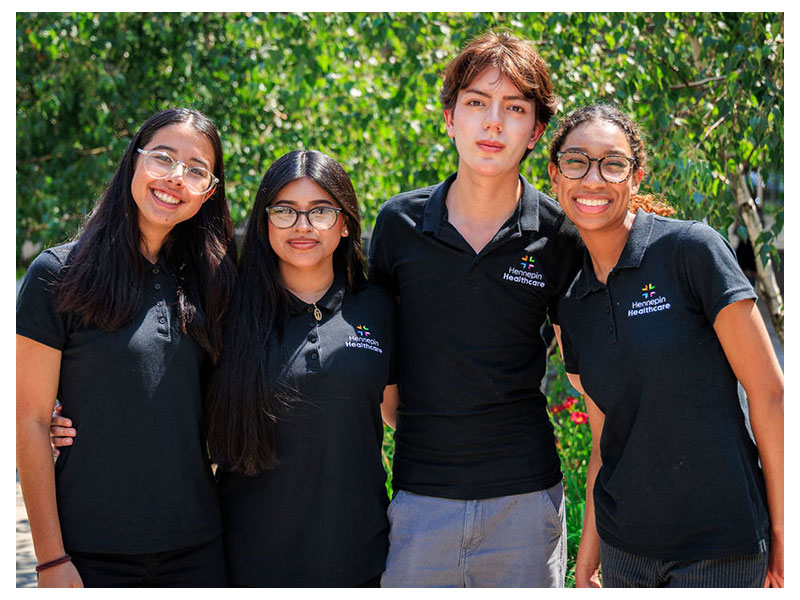
Lyn Ampey, Abigail Putz, Amy Vasquez, and Martin Villalba… Remember these names.
These are the 2025 Hennepin Healthcare Talent Garden CHEST Scholars—some of the nation’s brightest and most promising future medical professionals.
Through a competitive selection process, CHEST awarded these four students all-expenses-paid scholarships to attend CHEST 2025 and participate in an innovative, six-week, paid internship at Hennepin County Medical Center in Minneapolis. All high school seniors from throughout Minnesota, the students will be among some of the youngest attendees at the annual meeting. On Monday, October 20, they will get the chance to present their research in the Exhibit Hall.
For CHEST, this is an opportunity to support a relatively new medical education program focused on serving underrepresented communities that is already impacting lives and the future face of the medical workforce. For this year’s four scholars, the program is a chance to visualize themselves as clinicians, researchers, or other types of medical professionals and to be ambassadors for their peers who have had similar lived experiences.
‘A Mini Med School’
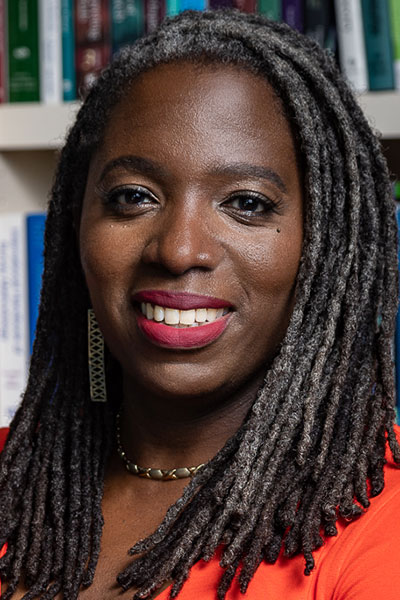
The Talent Garden program began as an idea that Nneka Sederstrom, PhD, MPH, MA, FCCP, was ruminating on in the late 2010s and early 2020s.
As Chief Health Equity Officer at Hennepin Healthcare in Minneapolis, Dr. Sederstrom wanted to create an opportunity for students of underrepresented communities to spend a Saturday conference with medical professionals, ideally those who looked like them or shared similar backgrounds. These meetings would allow the students to share time and space with medical professionals and be exposed to the notion that they, too, could step into these roles.
“Initially, I wanted it to be a massive, one-day convention with 1,000 kids and a convention center—a mini med school, a mini med convention… a baby CHEST,” Dr. Sederstrom said. “We would have speakers who would talk about their life, their journey, and how they became a clinician—and the kids could interact with them and ask questions.”
As planning continued, the size of that event evolved, she said, but its fundamental goals remained the same: “to create this opportunity for kids to not only see themselves in these spaces but know that there are people like them who are already there.”
The programs begin
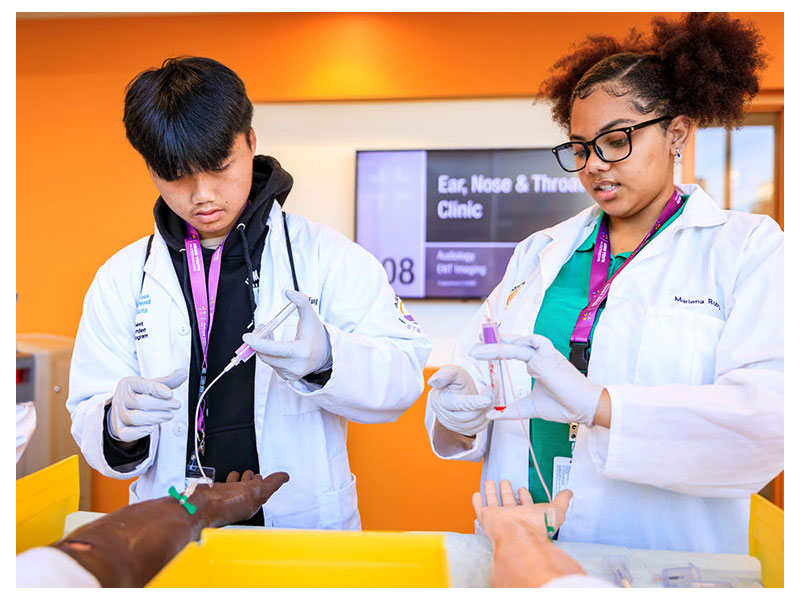
Kicking off in December 2021, the first Saturday program, the Black Men with Stethoscopes Youth Summit, brought in approximately 88 middle school and high school Black male students for a one-day seminar, during which they heard about the work and research being done by Black male medical professionals and were able to participate in some simulations.
The choice to focus initially on Black male students was intentional, based on the demographics of the Minneapolis region and in response to studies at the time, such as a report by the Association of American Medical Colleges in which only 3% of total US medical school applicants self-identified as Black men.
The success of this initial program allowed the Talent Garden to rapidly expand. Now, supported by Hennepin Healthcare with primary funding from Blue Cross and Blue Shield of Minnesota, the Talent Garden offers multiple six-hour events each school year: Latine Youth with Stethoscopes, Black Youth with Stethoscopes, Asian Youth with Stethoscopes, and American Indian Youth with Stethoscopes.
As the Talent Garden approaches its four-year anniversary, it has hosted 15 separate summits for 1,183 young students of color.
Dr. Sederstrom pointed to moments behind the numbers that further illustrate the program’s success.
For example, she recalled sitting in on a presentation by Thomas Wyatt, MD, Chair of the Department of Emergency Medicine at Hennepin Healthcare and an Associate Professor of Emergency Medicine at the University of Minnesota. An enrolled citizen of both the Shawnee (Saawanooki) and the Quapaw (Ogapah) nations, Dr. Wyatt shared with students how he was repeatedly discouraged from going to college and applying to medical school, and how these barriers and prejudice followed him through his early career.
“And this kid was listening,” Dr. Sederstrom recalled, “and asked: ‘People are always telling me I won’t amount to anything. How did you get over the fact that everybody was telling you that you couldn’t do it?’ And Dr. Wyatt looked at him and said, ‘I just had to believe that it was not true. Now, look at me—you can tell it isn’t true.’ And the kid was silent and looked at Dr. Wyatt like, ‘Yes, you did that—and I can do this.’ It was a powerful moment.”
The interns
Since 2022, the Talent Garden has also added an annual, intensive six-week summer internship for high school students.
The first cohorts from these groups are now nearing the completion of their undergraduate degrees and taking places at medical programs.
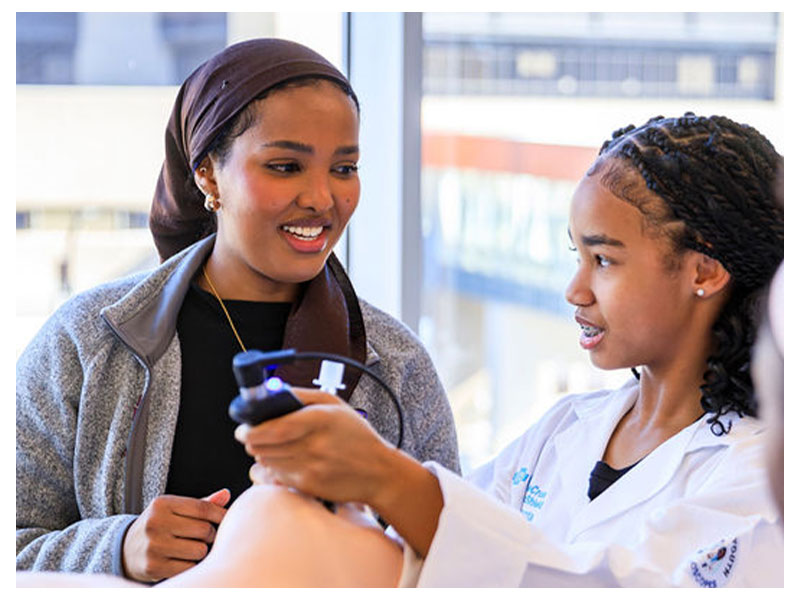
Jim Peters, Health Equity Program Development Manager for Hennepin Healthcare and the Talent Garden program coordinator, explained that each student will leave the program with a range of clinical experiences—from working at a radiology lab to standing in on knee-replacement surgeries and childbirths—as well as encounters with people who might become mentors for life.
Peters said that the enjoyment and reward the medical professionals receive from mentoring these interns has been an inspiring development.
“The kids pick up a lot of confidence, reassurance, and support from their mentors, and we have a number of physicians and nurses at all stages of their careers who have stayed in touch with these young people,” he said. “A couple of times, the past interns have written me and said, ‘Would I be bothering this doctor if I wrote to them?’ And I have responded, ‘Bother them! They’ll be delighted to know you got into Notre Dame, Rutgers, the University of Minnesota, or to the university you wanted, or to learn that you’re doing neurology research this summer!’”
As the program has grown and improved, Peters said he finds himself thinking that what the Talent Garden might do best is identify youth who are already talented and provide an experience to inspire them to achieve what they clearly have the potential to do.
“Even if we’re just giving them rollerblades to move along on their journey a bit faster, the fact that young people of such caliber are excited enough to join this program tells me we are doing something right,” he said.
Looking ahead
Both Peters and Dr. Sederstrom said they expect the Talent Garden to have a cumulative impact over the years. Some of the program’s graduates are already working as emergency responders and building up their finances and careers. All Talent Garden internship graduates have gone on to colleges or universities—an impact that will lead to expanded opportunities.
Ideally, Talent Garden organizers want their program—or ones like it—to be a common opportunity throughout the nation. They’ve supported the launch of a similar program in Bemidji, Minnesota, and are eager to share their experiences with any other community looking to replicate or share ideas with them.
“I am happy to give anybody the road map of how we did it because we can’t be the only solve for this,” Dr. Sederstrom said. “If we’re alone, then the bit we are doing is not going to increase the number of kids of color as clinicians and in other health spaces across the nation. Everybody should have a program like this for their community to create clinicians who look like the community they represent.”
To support this program, as well as other CHEST scholarship and grant initiatives, visit chestnet.org/donate and select “Dedication to education.”
A Scholar’s Story
As part of the selection process to become a 2025 Hennepin Healthcare Talent Garden CHEST Scholar, applicants were required to write an essay about their experience as a student intern. Here is one application, reprinted with the author’s permission and edited slightly for length.
During my time in the Emergency Department, I saw a wide range of patients. Some were just like I expected: blood everywhere, oxygen masks, with providers swarming the bed. Others, however, were less dramatic, like cases of abdominal pain or fainting. What surprised me the most were the patients in Team Center D [TCD]. As I walked into the center, the sounds and sights of people in states of physical and emotional pain hit me. Their distress was very different from the hurt I witnessed in the other areas of the ED.
Dr. Travis O, the physician I was shadowing, explained that Team Center D was an area where patients are often sent to “sober up,” usually from alcohol or drugs. He explained that people, both outside and within the hospital, are often critical of TCD—they believe that it is a place where providers take people off their “high,” or that it’s a waste of hospital resources. Despite the skepticism, Dr. O treated his patients with genuine care and instilled in the TCD resident and me the importance of advocacy for and care of the patients in TCD.
I also learned the importance of community in the ED. During the first rounds, I felt tense walking into the heavy atmosphere of patient rooms. However, I soon realized how much a simple sense of community can change that atmosphere. Whether it was with a ginormous wrestler, a mother who spoke Spanish with her kids, or a middle-aged teacher, Dr. O always found a way to connect with them. I concluded [that] a sense of community is essential in health care; it can put everyone, both providers and patients, at ease, and overall creates a less terrifying and stressful experience for patients in the ED.
I also experienced a sense of community between providers. At the beginning of the shadow, Dr. O and I went over to the Acute Psychiatric Care unit. At first, I thought we were there to visit patients; however, the doctor explained to me that he stops by just to build community and maintain a close relationship between the ED and the psychiatric unit. He also often stopped to check in on the ED residents and took time to pass on his knowledge.
Similarly, the Coordinated Care Clinic [CCC] strongly embodied advocacy and community. The CCC serves medically complex patients who frequently use the ED for primary care due to complications as a result of behavioral or social determinants, such as housing, transportation, or alcohol/substance abuse disorders. The CCC is cross-functional, with internal medicine physicians, a psychologist, dental care, nurse coordinators, and even social workers. This team perfectly embodies the values of advocacy and community because its sole purpose is to help underresourced members of our community.
Witnessing the dedication and passion of Dr. O and the CCC team was deeply moving; it reinforced that every patient deserves appropriate care, free from judgment and barriers of social determinants. My shadowing experiences inspire me to pursue my dreams of being a physician and foster similar communities of knowledge and empathy to advocate for adequate care for all patients.
After the Garden
The first groups of Talent Garden graduates have continued their education and early career success.
Of the 65 former interns (2022–2024)…
23 are pursuing premedical studies
20 have entered nursing school
4 of these 20 nursing school students are working as CNAs while in school
4 are studying to become physician assistants/associates
3 are studying to become clinical psychologists
2 are studying to become dental hygienists
2 are enrolled in a seven-year BA/MD program
1 is studying to become a licensed clinical social worker
Talent Garden interns have enrolled in several colleges and universities, including: The City College of New York, University of Wisconsin–Madison, University of Notre Dame, University of San Diego, Carleton College, Loyola Marymount University, the University of Minnesota, and more.
Collectively, the past and present Talent Garden interns speak at home, or are fluent in, the languages that follow (in addition to English): American Sign Language, Amharic, Arabic, Cantonese, French, Fulani, Korean, Hmong, Japanese, Lakota, Oromo, Spanish, Somali, and Swahili.
Call for Topics Is Open
Feeling inspired by all the great sessions in Chicago? Help shape the curriculum for CHEST 2026, October 18 to 21 in Phoenix, by submitting topic ideas from areas you’re passionate about, topics affecting your practice, or new technologies you’d like to learn more about. The submission deadline is Tuesday, December 2, at 2 pm CT.