

As the third-leading cause of death worldwide, COPD remains a major public health concern even as treatment options improve.1 Projections show an estimated 645.6 million people will have COPD by 2050, which equates to a 36% relative increase in global prevalence since 2020.2
About one-half of patients with COPD continue to experience exacerbations despite adequate adherence to inhaled triple therapy with an inhaled corticosteroid (ICS), a long-acting β₂-agonist (LABA), and a long-acting muscarinic antagonist (LAMA).3 Additionally, 20% to 40% of patients with COPD have evidence of type 2 inflammation, which is associated with increased exacerbation risk and accelerated lung function decline.4
Building on the success of biologics in asthma, a similar precision medicine approach is improving outcomes for select patients with COPD, with blood eosinophils emerging as a key biomarker. The 2026 report from the Global Initiative for Chronic Obstructive Lung Disease recommends adding biologic therapy for patients with one severe or two moderate exacerbations despite adherence to triple therapy if the patient’s absolute blood eosinophil count is 300 cells/µL or greater.5

Despite the recent approvals of dupilumab and mepolizumab, not all biologics targeting eosinophilic inflammation have demonstrated consistent benefit in COPD. Benralizumab, an interleukin (IL)-5 receptor α antagonist approved by the US Food and Drug Administration for severe eosinophilic asthma, did not meet the primary endpoints in the phase 3 GALATHEA and TERRANOVA trials. Subsequent findings from the phase 2 ABRA trial suggested a potential role for benralizumab during acute eosinophilic exacerbations, with benralizumab demonstrating superiority to oral prednisolone.6
In addition, the results of the RESOLUTE study of benralizumab were announced in 2025. Despite showing numerical improvement compared with placebo, benralizumab did not achieve statistical significance for the primary end point—the annualized rate of moderate or severe COPD exacerbations over 56 weeks.7
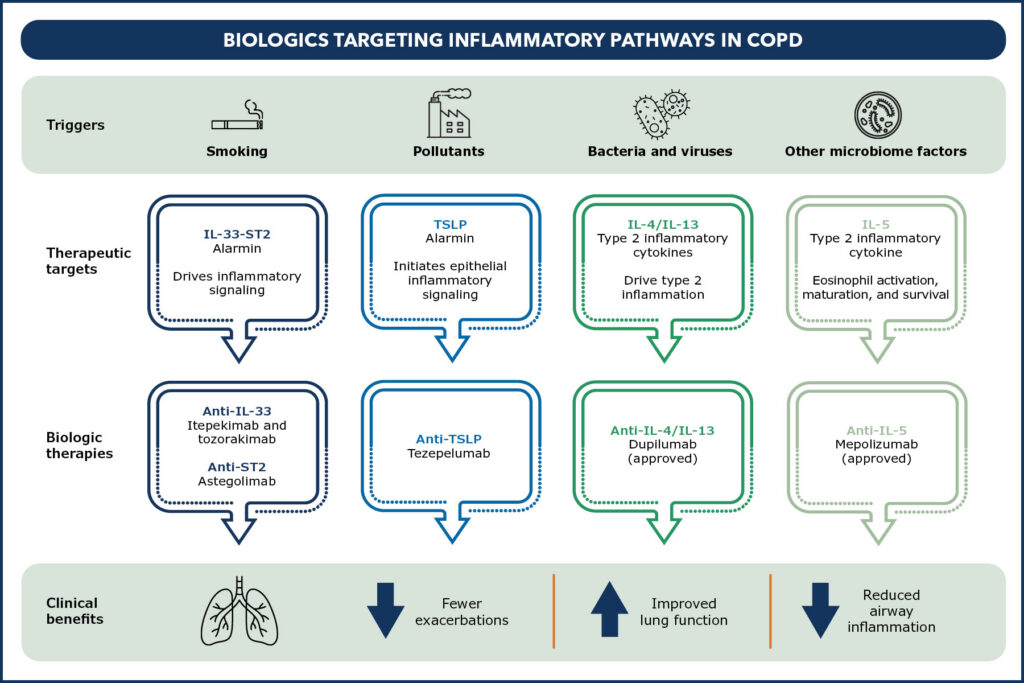
Another inflammatory pathway under investigation is IL-33, with tozorakimab emerging as one of the leading investigational therapies. Positive findings from the OBERON and TITANIA trials, together with results from MIRANDA, have suggested potential benefit across a broader range of patients with COPD.8 More recently, the phase 2a FRONTIER-4 trial further supported this by demonstrating encouraging efficacy among patients at high risk for exacerbations despite not meeting its primary end point.9
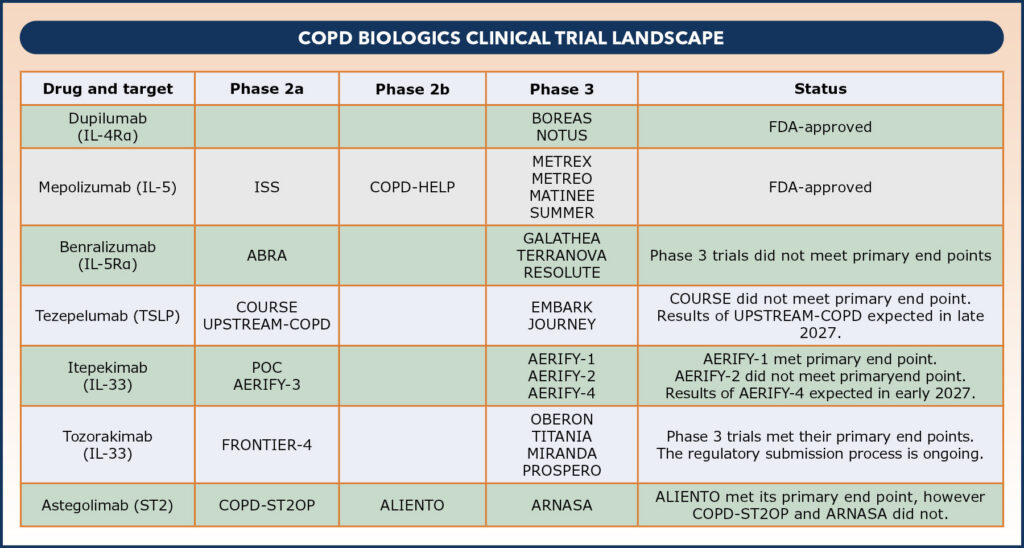
Other investigational agents targeting the IL-33 pathway include itepekimab and astegolimab. However, results have been mixed. AERIFY 1 showed a reduction in exacerbations, but the results were not reproduced in AERIFY 2.10 In the phase 2 ALIENTO study, astegolimab was associated with lower exacerbations in patients with COPD, while in the phase 3 ARNASA trial, it did not reach statistical significance.11,12 In addition, the phase 2a COPD-ST2OP evaluating astegolimab showed a nonsignificant reduction in exacerbation rates compared with placebo.11
Researchers have also investigated upstream inflammatory targets, including thymic stromal lymphopoietin (TSLP). Tezepelumab, a monoclonal antibody targeting TSLP, did not meet the primary end point in the phase 2a COURSE trial.13 However, the results identified a subgroup of patients who may derive greater benefit, findings that have informed ongoing phase 3 studies.
Emerging next-generation therapies, including bispecific antibodies such as lunsekimig that simultaneously target TSLP and IL-13, reflect the continued evolution of biologic therapy beyond single-pathway inhibition.14
This article was originally published in the Fall 2026 issue of CHEST Physician.
References
1. World Health Organization. Chronic obstructive pulmonary disease (COPD). Published June 10, 2026.
2. Boers E, Barrett M, Su JG, et al. Global burden of chronic obstructive pulmonary disease through 2050. JAMA Netw Open. 2023;6(12):e2346598. doi:10.1001/jamanetworkopen.2023.4659
3. Halpin DMG, Dransfield MT, Han MK, et al. The effect of exacerbation history on outcomes in the IMPACT trial. Eur Respir J. 2020;55(5):1901921. doi:10.1183/13993003.01921-2019
4. Rabe KF, Rennard S, Martinez FJ, et al. Targeting type 2 inflammation and epithelial alarmins in chronic obstructive pulmonary disease: a biologics outlook. Am J Respir Crit Care Med. 2023;208(4):395-405. doi:10.1164/rccm.202303-0455CI
5. Global Initiative for Chronic Obstructive Lung Disease. 2026 GOLD Report and Pocket Guide. Published November 2025.
6. McGovern G. Benralizumab achieves positive outcomes in eosinophilic exacerbations in asthma, COPD. Pharmacy Times. Published December 12, 2024.
7. AstraZeneca. Update on the RESOLUTE Phase III trial for Fasenra in chronic obstructive pulmonary disease. Published September 17, 2025.
8. AstraZeneca. Tozorakimab met primary endpoint in both OBERON and TITANIA Phase III trials in patients with COPD. Published March 17, 2026.
9. Singh D, Guller P, Reid F, et al. A phase 2a trial of the IL-33 monoclonal antibody tozorakimab in patients with COPD: FRONTIER-4. Eur Respir J. 2025;66(1):2402231. doi:10.1183/13993003.02231-2024
10. Kaltwasser J. Itepekimab shows mixed results in phase 3 COPD trials. AJMC. Published July 9, 2025.
11. Yousuf AJ, Mohammed S, Carr L, et al. Astegolimab, an anti-ST2, in chronic obstructive pulmonary disease (COPD-ST2OP): a phase 2a, placebo-controlled trial. Lancet Respir Med. 2022;10(5):469-477. doi:10.1016/S2213-2600(21)00556-7
12. Papi A, Greening NJ, Bhatt SP, et al. Safety and efficacy of astegolimab for COPD with frequent exacerbations regardless of baseline blood eosinophil counts (ALIENTO and ARNASA): randomised, double-blind, placebo-controlled, phase 2b and 3 trials. Lancet. 2026;407(10543):2027-2039. doi:10.1016/S0140-6736(26)00637-9
13. Singh D, Brightling CE, Rabe KF, et al. Efficacy and safety of tezepelumab versus placebo in adults with moderate to very severe chronic obstructive pulmonary disease (COURSE): a randomised, placebo-controlled, phase 2a trial. Lancet Respir Med. 2025;13(1):47-58. doi:10.1016/S2213-2600(24)00324-2
14. Sanofi. Sanofi’s lunsekimig met primary and key secondary endpoints in phase 2 respiratory studies in asthma and CRSwNP. Published April 7, 2026.
