

The term “zebra” in health care originates from the medical adage, “When you hear hoofbeats, think horses, not zebras.” Coined by Dr. Theodore Woodward, this phrase warns against overdiagnosing rare conditions.1 But just as practitioners sometimes encounter unexpected diagnoses in clinical practice, an unexpected scenario in health care administration began nearly 15 years ago. This uncommon scenario involves navigating unprecedented regulatory changes and taking advantage of new revenue sources. It was this “zebra” in health care administration that was the catalyst for an exciting and fulfilling professional experience—and one that I am eager to share.
Hospital readmission reduction and transitional care billing
The Hospital Readmissions Reduction Program (HRRP) was established by Congress in 2010 as part of the Affordable Care Act (ACA) to incentivize reduced readmissions for Medicare beneficiaries. The program reduces payments to hospitals with higher-than-expected 30-day readmission rates for specific conditions. The program originally targeted heart failure, acute myocardial infarction, and pneumonia. It has since expanded to include COPD, hip/knee replacements, and coronary artery bypass graft surgeries. Since 2010, the program has been credited with preventing more than 565,000 readmissions.2
Transitional care management (TCM) billing was established by the Centers for Medicare and Medicaid Services (CMS) three years later. These codes (CPT 99495 and 99496) were introduced to reimburse physicians and qualified practitioners for care coordination services provided to patients transitioning from an inpatient setting back to the community.3 The initiative was created to improve patient follow-up care.
The combination of the HRRP and TCM billing created a “zebra” in the patient, practitioner, and payor relationship—specifically, the rare instance where the best interests of the patient, the practitioner, and the payor all align.
COPD transitional care clinic structure
In August 2018, I helped organize a COPD transitional care clinic in Carson City, Nevada, led by advanced practice providers (APP), with the mission of lowering readmissions for patients discharged with acute exacerbation of COPD. Acute exacerbations alone are responsible for up to 70% of COPD-related health care costs, and hospital readmissions alone account for more than $15 billion annually.2 Fewer than half of these patients are alive at five years following their initial exacerbation requiring hospitalization, driving a clear use case for more effective postdischarge intervention.2
The clinic’s team included an APP, a registered nurse (RN), and a medical assistant (MA). The APP rounded at the hospital in the mornings and worked in the outpatient clinic in the afternoons. The RN arranged follow-up appointments and managed prescriptions, as well as tracked patient outcomes including readmissions. The MA handled triage calls, prepared charts, and supported clinic operations.
Rounding in the hospital by the APP helped connect patients with outpatient providers for continued care and supported best-practice discharge planning. The nurse navigator contacted patients within two days of discharge and scheduled follow-ups within one to two weeks, both important for TCM billing. They also assessed patient needs such as access to inhaled medications, providing samples if needed, and coordinated with the APP to determine long-term solutions, including identifying patient assistance programs and local charities. Along with the MA, they arranged durable medical equipment orders like oxygen and nebulizers, as indicated.
The initial outpatient hospital follow-up visits with the APP typically lasted 60 minutes and included assessing patient recovery, determining medication and therapy compliance, and addressing immediate concerns. They also reviewed events before hospitalization to identify early signs of exacerbation and explain the process, discussed imaging and lab results, and answered lingering questions pertaining to hospitalization.
Patients were reminded they could contact the clinic if recovery issues arose, and they were given a direct phone number for the clinic MA’s desk. Follow-up appointments were scheduled in two or four weeks based on readmission risk. Office notes were sent to the primary care provider and pulmonologist, or a referral to outpatient pulmonary was provided, if needed.
The relationship between the patient and the clinic lasted between 30 and 90 days following hospital discharge with the intent to provide education and encouragement to the patient and their caregivers. If everything went well, the patient would have access to strategies, medications, and interventions that would keep them from another hospitalization or—at the very least—delay their next exacerbation beyond the 30- to 60-day period that would qualify for CMS penalties.
Statistical analysis of the data
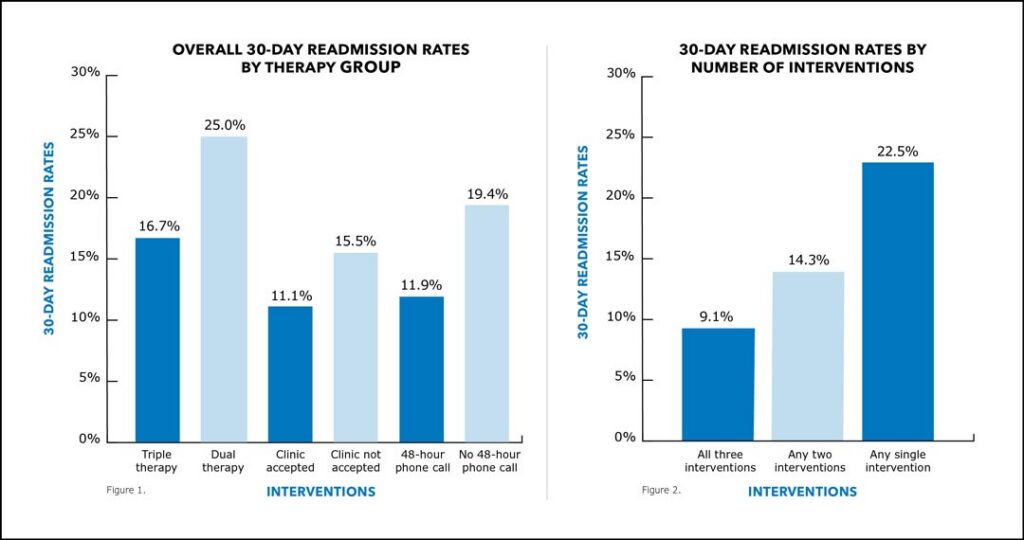
A longitudinal study of the spreadsheet kept by this clinic from 2019 to 2025 tracked a total of 2,305 hospital events and revealed value to several interventions, including early contact, education-focused visits, care coordination, and continuity. Patients contacted by the clinic within 48 hours had a readmission rate of 11.9% compared with 19.4% in patients who were not contacted within 48 hours. Patients who accepted engagement with the clinic had an average 30-day readmission rate of 11.1% compared with 15.5% for those who chose not to engage.4
In 2020, discharge medications were tracked along with severity of COPD in patients who had prehospital spirometry. In patients with moderate to severe COPD who were discharged on long‐acting muscarinic antagonist (LAMA)/long‐acting β‐agonist (LABA) therapy alone, the readmission rate was 25% vs 16.7% for patients on inhaled corticosteroid/LAMA/LABA therapy.4 (See Figure 1)
While any of these interventions were better than no intervention, the combination of these interventions showed that bundled transitional care far outweighed any intervention by itself. Patients who experienced any one intervention had a readmission rate of 22.5%, compared with 14.3% for patients who experienced any two interventions and 9.1% for patients who experienced all three interventions.4 (See Figure 2)
Clinic implementation costs included hiring a full-time APP, RN, and MA, plus added overhead. Within six years, the health system eliminated HRRP penalties, increased revenue reimbursement, and began TCM and standard outpatient billing.4 The APP generated 3,000 work relative value units (wRVUs) in 2022, which increased yearly, up to 4,500 wRVUs in 2025.4 Revenue for RN services was not pursued due to billing barriers, though codes exist for telephone calls (CPT 98966–98968) and nurse-only visits (CPT 99211), which could supplement APP visits for ongoing patient needs beyond 30 to 60 days postdischarge.6,7
The data show that dynamic transitional care clinics provided with adequate resources are effective. They work for the best interests of all involved.
Final thoughts
There is still plenty to learn from this “zebra” in health care. There are several other examples of successful APP-led transitional care clinics in the United States, each of which has its own experience with improving outcomes for patients with COPD.5,8–10
Nationwide readmission rates have improved with the implementation of HRRP and TCM billing; but where are the other “zebras” in American health care? What strategies can be devised? What legislation needs to be passed?
We can look to the HRRP with TCM billing as a model to improve health care delivery in America and, hopefully, get to the point where universal interest alignment is no longer a “zebra.”
This article was originally published in the Summer 2026 issue of CHEST Physician.
References
1. Sotos JG. Zebra cards: an aid to obscure diagnosis. Philadelphia, PA: American College of Physicians; 1989.
2. Press VG, Konetzka RT, White SR. Insights about the economic impact of chronic obstructive pulmonary disease readmissions post implementation of the hospital readmission reduction program. Curr Opin Pulm Med. 2018;24(2):138-146. doi:10.1097/MCP.0000000000000454
3. Centers for Medicare & Medicaid Services. Frequently asked questions about billing the Medicare physician fee schedule for transitional care management services. Published March 17, 2016.
4. wRVU data provided to the provider at Carson Tahoe Medical Group. Unpublished data.
5. Myers LC, Faridi MK, Hasegawa K, Hanania NA, Camargo CA Jr. The Hospital Readmissions Reduction Program and readmissions for chronic obstructive pulmonary disease, 2006-2015. Ann Am Thorac Soc. 2020;17(4):450-456. doi:10.1513/annalsats.201909-672oc
6. Centers for Medicare & Medicaid Services. MLN Matters article MM12126: 2021 annual update to the therapy code list. Published December 31, 2020.
7. Giovino JM. Coding level-one office visits: a refresher course. Fam Pract Manag. 2000;7(7):39-42.
8. Yakusheva O, Hoffman GJ. Does a reduction in readmissions result in net savings for most hospitals? An examination of Medicare’s hospital readmissions reduction program. Med Care Res Rev. 2020 Aug;77(4):334-344. doi:10.1177/1077558718795745
9. Au DH, Collins MP, Berger DB, et al. Health system approach to improve chronic obstructive pulmonary disease care after hospital discharge: stepped-wedge clinical trial. Am J Respir Crit Care Med. 2022;205(11):1281-1289. doi:10.1164/rccm.202107-1707oc
10. Barrett JB, Trambley A, Blessinger EK, et al. Reduced hospital readmissions through personalized care: implementation of a patient, risk-focused hospital-wide discharge care center. NEJM Catal Innov Care Deliv. 2025;6(6):10.1056/cat.24.0420. doi:10.1056/cat.24.0420
