

Asthma epidemiology and economic impact
Approximately 260 million individuals globally have asthma, with an age-standardized prevalence rate of 3,340 per 100,000 people. In the United States, asthma affects approximately 20 million adults, 5% to 10% of whom have severe uncontrolled asthma. The economic costs of asthma exceed $50 billion annually in the United States. Approximately 8.8 per 100 people with asthma per year have an emergency department visit, resulting in 450,000 hospitalizations in the United States. It is estimated that 15% to 50% of asthma-related hospitalizations are preventable through education, lifestyle management, and medications, including biologics.
Patient selection for biologics (who, when, how)
Biologic therapy is recommended for patients with severe asthma who have uncontrolled symptoms despite optimized comorbidities and adherence to high-dose inhaled corticosteroid plus long-acting β₂-agonist therapy. Candidates predominantly demonstrate a type 2 inflammatory profile, defined by presence of one or more of these findings: blood eosinophil count of ≥ 300 cells/µL, elevated immunoglobulin E, or Feno of ≥ 25 ppb.
However, there are also treatment options for patients with a non-type 2 inflammatory profile. Recurrent exacerbations (two or more annually) or oral corticosteroid (OCS) dependence strengthen eligibility. Selection should integrate biomarker profile, comorbidities, and exacerbation burden using a structured algorithm, with reassessment at four to six months to confirm clinical response and justify continuation or therapeutic modification.
Choosing the right biologic
A)
Asthma with comorbidities
Patients with severe asthma frequently present with comorbid conditions such as chronic rhinosinusitis with nasal polyps, atopic dermatitis, or eosinophilic esophagitis, all of which have a significant effect on achieving asthma control. There is overall agreement that the assessment of comorbidities in addition to biomarkers is essential for tailoring biologic therapies for severe asthma.
Clinical decision-making in patients with comorbidities should incorporate:
- Analysis of the shared pathogenetic pathways
- Availability of an approved biologic targeting both conditions
- Defining response by combining asthma and comorbidity-relevant outcomes
There are no randomized controlled trials in which biologics address both asthma and its comorbidities as a primary outcome. Most of the data collected are from either post hoc analysis or disease registries. Therefore, the current CHEST guideline provides guidance on treating comorbidities in the format of conditional recommendations.1
B)
Asthma with OCS dependence
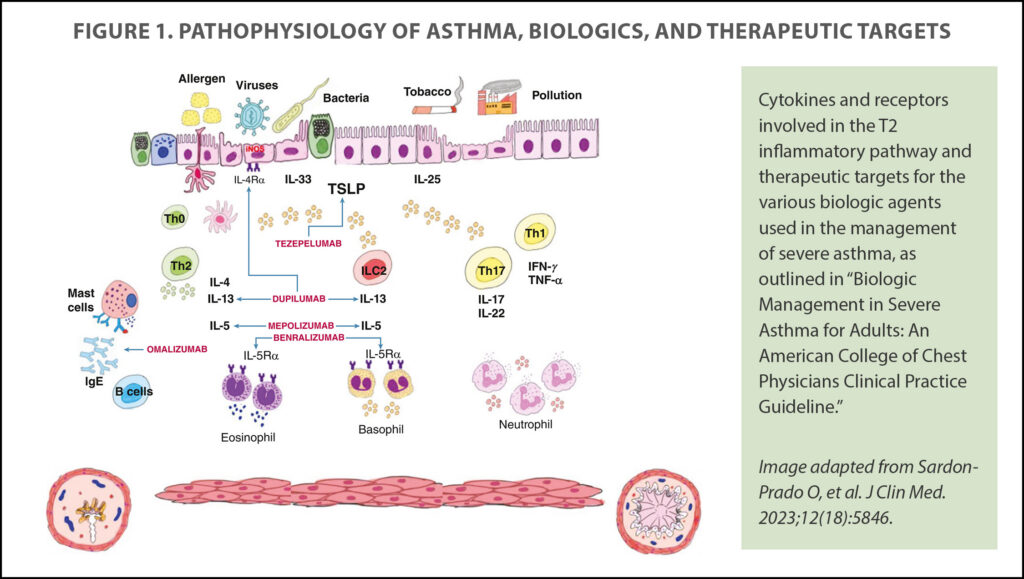
Given the well-described adverse effects of OCS, they need to be considered not just for those on daily OCS but also for those prescribed OCS during exacerbations. There is good evidence for reducing OCS burden in severe asthmatics for dupilumab, specifically for patients who are “steroid-dependent” on daily OCS. Additionally, anti-interleukin-5 (anti-IL-5)/5Rα agents also show reductions in daily OCS use. And for patients with significant peripheral eosinophilia (especially despite daily OCS use), the effect may be even more pronounced. Notably, despite improvement in key asthma-related outcomes, some other biologics do not show consistent improvement in cumulative OCS use (eg, tezepelumab).
When deciding which biologic agent to start on patients who do not require daily OCS, the clinician must consider exacerbation frequency and select the biologic agent that is most likely to decrease annual exacerbations based on biomarker assessment. If a patient response is deemed inadequate based on usual criteria after four to six months, change to an alternate agent is indicated.
Biologic switching
Despite careful patient selection for clinical trials, a subset of patients continue to demonstrate suboptimal response to initial biologic therapy. Reasons include heterogeneity of inflammatory pathways, overlapping endotypes, or non-type 2 disease. Biologic switching has emerged as a pragmatic strategy in patients who are not responding to treatment. Patients who do not demonstrate the desired response to the first-choice biologic are likely to be eligible for others. Ongoing steroid dependence should prompt the clinician to consider those biologics shown to reduced overall systemic OCS exposure first. Additionally, the use of Feno can help select the next best potential agent with both anti-IL-4/anti-IL-13 and anti-thymic stromal lymphopoietin, showing a positive response in those with elevated Feno levels.
Guidelines recommend reassessment after four to six months of therapy using objective outcomes such as exacerbation reduction, steroid requirement, symptom control, and biomarkers. Lack of clinically meaningful improvement should prompt reconsideration of adherence, comorbidities, and potentially switching biologics.
Role of fractional excretion of nitric oxide in evaluation and management of asthma
Elevated Feno reflects IL-4/13-mediated stimulation of inducible nitric oxide synthase in airway epithelium and is a useful biomarker in severe asthma. Feno can guide biologic selection when patients do not respond to anti-IL5/5Rα after four to six months. Higher Feno levels predict greater reductions in exacerbations with dupilumab, but not with anti-IL-5/IL-5Rα therapy. Tezepelumab also reduces exacerbations in patients with elevated or low Feno levels, but the effect is more pronounced in those with elevated Feno levels. Implementation of Feno testing in clinical practice depends on equipment availability, trained staff, and insurance coverage.
Challenges with obtaining biologics
The challenges to obtain biologics for patients are multifactorial. The need for prior authorizations can pose a major barrier to treatment. In a survey of 259 health care professionals, 71% of the respondents described the burden of prior authorizations as extremely high. Other barriers include patient costs, lack of commercial insurance, and lack of access to a specialist. In a study by Inselman and colleagues, biologic use was higher in those with household incomes of more than $75,000 per year compared with those making less than $40,000 per year: 24.3% vs 9.7%, respectively.2 Similarly, having commercial insurance and an asthma exacerbation requiring hospitalization in the last 12 months were associated with higher rates of obtaining biologics. Those who do not have commercial insurance are likely to have undertreated asthma.
Call to action and future directions
Despite these challenges, increased access to appropriate biologics could be achieved in several ways. First, insurers should expedite the prior authorization process, which can take up to two weeks or even longer when denials are issued. In addition, the need for repeated authorization every six to 12 months should be removed, as this often leads to interruptions in therapy. Second, cost reduction is imperative. The Institute for Clinical and Economic Review in 2018 estimated that biologics would need 62% to 80% cost reduction to achieve cost-effectiveness. Therefore, these costs could be shared between governmental agencies, insurance companies and pharmaceutical companies.
Conclusion
Asthma remains widely prevalent in the United States and globally, and it imposes a significant economic burden. The advent of biologic therapy has been shown to improve patient outcomes and could potentially lower economic costs. Choosing the appropriate initial biologic and having the ability to implement timely changes in therapy, if needed, can lead to improved patient-centered outcomes in severe asthma.
Review the full Biologic Management in Severe Asthma for Adults guideline.
This article was originally published in the Summer 2026 issue of CHEST Physician.
References
1. Oberle AJ, Abbas F, Adrish M, et al. Biologic management in severe asthma for adults: an American College of Chest Physicians clinical practice guideline. Chest. 2026;169(2):336-348. doi:10.1016/j.chest.2025.08.042
2. Inselman JW, Jeffery MM, Maddux JT, Shah ND, Rank MA. Trends and disparities in asthma biologic use in the United States. J Allergy Clin Immunol Pract. 2020;8(2):549-554.e1. doi:10.1016/j.jaip.2019.08.024