

It is 2 am. A patient’s condition has deteriorated, and a family meeting is called. A professional interpreter joins the discussion. The prognosis is explained, the immediate plan of care is discussed, questions are answered, and the patient’s family nods in agreement. The meeting ends with the reassurance that everyone understands the plan.
Before morning rounds, a family member asks a question that reveals uncertainty about the patient’s condition and the plan. This is not because anyone failed to communicate. Rather, it reflects the reality that communication in critical care is rarely a singular event. In the ICU, language, uncertainty, emotional distress, and health literacy converge at some of the most difficult moments that patients and families will ever face. Shared understanding develops over time, and that distinction matters.1,2
Experiences like these remind us that completion of a conversation does not necessarily reflect shared understanding.That distinction has important implications for the way we communicate with patients and families in the ICU.

As critical care continues to evolve, one of our greatest responsibilities is to ensure that patients and families truly understand the conversations guiding their care. True shared decision-making requires patients and families to have a clear and comprehensive understanding of their condition and outcomes.
Communication beyond translation
Language discordance occurs when patients or families have limited English proficiency, creating communication barriers that often require professional interpreter services. But truthfully, interpretation is only the beginning. ICU conversations involve prognosis, informed consent, goals of care, and uncertainty—discussions that require far more than just accurate translation.4,5 True shared decision-making depends on patients and families understanding the patient’s condition, prognosis, and expected outcomes.5,7
Unlike many other clinical settings, decisions made in the ICU unfold under intense emotional stress and rapidly changing circumstances. Families often meet the ICU team for the first time while processing a deluge of unfamiliar medical information and making critical decisions about their loved one’s care. Even when every word is translated accurately, understanding may still require repetition, reflection, and time.5,6
The literature reflects what many intensivists recognize in practice: Patients and families with limited English proficiency face greater challenges during serious illness discussions and may participate differently in decisions that shape their care. Professional interpreters remain indispensable to equitable care. Translation conveys words; shared understanding conveys meaning.2,3,7
From interpretation to shared understanding
Improving communication does not require new technology (though virtual or remote interpreters can aid communication, thereby increasing access to needed services). It begins with intentional practice.
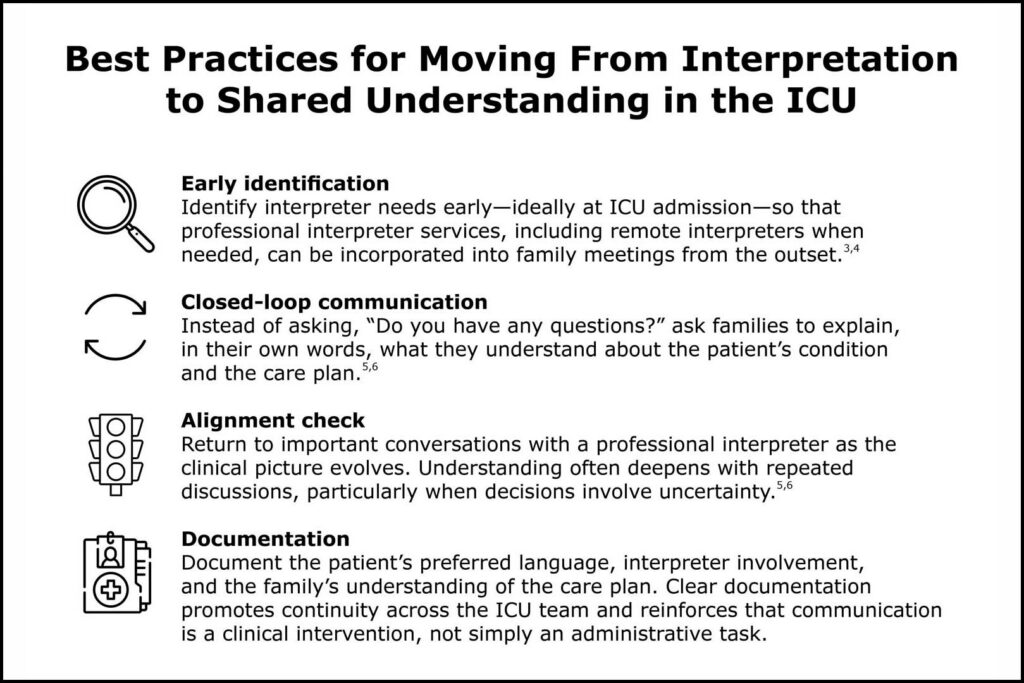
These simple practices move communication from a completed task to an ongoing clinical process.
Looking ahead
Critical care has embraced quality improvement across nearly every aspect of practice. Communication deserves the same attention. As technology continues to transform intensive care, one of our greatest opportunities to improve patient-centered care may not be another device or therapy but rather ensuring that every patient and family leaves a conversation in the ICU with genuine understanding rather than simply translated words.4,5
Completion of a family meeting should never be mistaken for completion of understanding.
Ultimately, the goal of every conversation in the ICU is not simply to exchange information but to build shared understanding.
References
1. Pham K, Thornton JD, Engelberg RA, Jackson JC, Curtis JR. Alterations during medical interpretation of ICU family conferences that interfere with or enhance communication. Chest. 2008;134(1):109-116. doi:10.1378/chest.07-2852
2. Thornton JD, Pham K, Engelberg RA, Jackson JC, Curtis JR. Families with limited English proficiency receive less information and support in interpreted intensive care unit family conferences. Crit Care Med. 2009;37(1):89-95. doi:10.1097/CCM.0b013e3181926430
3. Holdsworth LM, Kling SMR, Winget M, et al. Quality of serious illness communication with hospitalized limited English proficient patients: a mixed methods study. Palliat Med Rep. 2025;6(1):282-290. doi:10.1089/pmr.2025.0005
4. Karakus IS, Ahmad SR, Barwise AK. Shared decision-making in the ICU: communicating with patients who speak a language of lesser diffusion. Chest. 2025;167(5):1462-1467. doi:10.1016/j.chest.2025.02.001
5. Kon AA, Davidson JE, Morrison W, et al. Shared decision making in ICUs: an American College of Critical Care Medicine and American Thoracic Society policy statement. Crit Care Med. 2016;44(1):188-201. doi:10.1097/CCM.0000000000001396
6. Azoulay E, Chaize M, Kentish-Barnes N. Involvement of ICU families in decisions: fine-tuning the partnership. Ann Intensive Care. 2014;4:37. doi:10.1186/s13613-014-0037-5
7. Scheunemann LP, Ernecoff NC, Buddadhumaruk P, et al. Clinician-family communication about patients’ values and preferences in intensive care units. JAMA Intern Med. 2019;179(5):676-684. doi:10.1001/jamainternmed.2019.0027
