

Vascular access is among the most routine parts of care in the ICU—and one of the easiest to take for granted. Clinicians face a growing array of options, from standard and extended-dwell peripheral IV catheters (PIVs) to midlines, peripherally inserted central catheters (PICCs), and traditional central venous catheters (CVCs). Choosing among them requires balancing the urgency of therapy, infusion characteristics, patient anatomy, and potential complications.
CVCs are not benign; depending on the site of cannulation, placement carries varying risks of bloodstream infection, thrombosis, and mechanical complications such as pneumothorax.1 Less invasive alternatives may therefore be appropriate when central access is not otherwise required. The MAGIC guidelines favor midlines or ultrasound-guided PIVs over PICCs for peripheral therapies expected to last six to 14 days, while PICCs should generally be avoided in advanced chronic kidney disease to preserve veins for future dialysis access.2,3 Undeniably, the “right” device is rarely fixed and may change as the patient’s condition and treatment needs evolve.
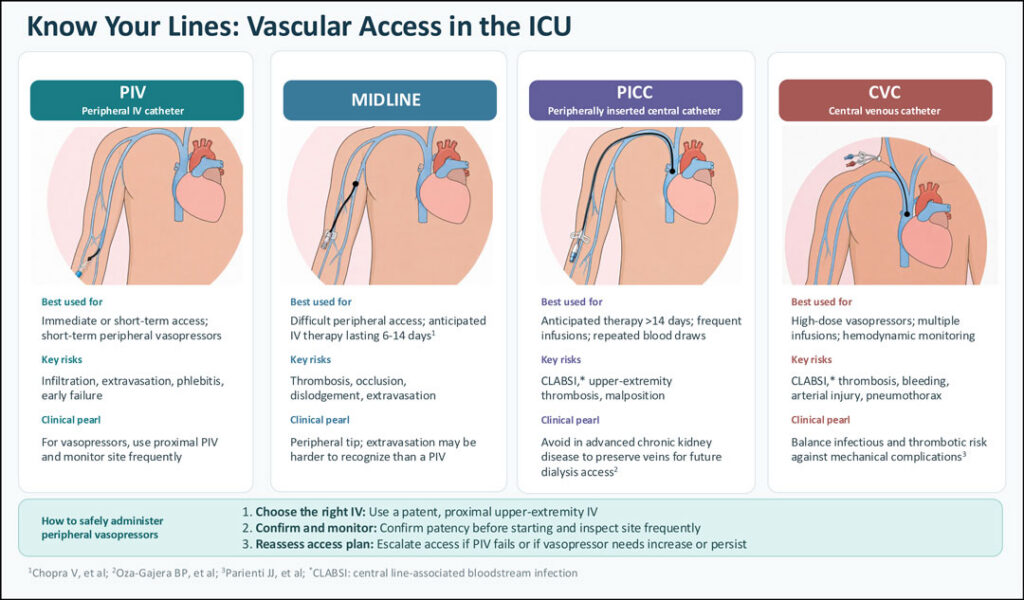
Nowhere is this shift more apparent than in vasopressor administration. Traditionally, CVCs have been considered the gold standard for vasopressor administration. However, the risks of central access, coupled with the need for timely vasopressor initiation, have driven a change in practice. Peripheral vasopressors are no longer an exception reserved for minutes before central access is obtained; they have become common practice nationwide. Yet implementation has outpaced the evidence needed to define how these agents can be used most safely and effectively.

This shift has now been acknowledged by the 2026 Surviving Sepsis Campaign, which recommends initiating vasopressors peripherally rather than delaying treatment until central access is secured.4 Although the certainty of evidence remains very low, observational data suggest that short-term peripheral administration is generally safe. A 2026 meta-analysis including more than 33,000 peripheral catheters reported minor adverse events in 2.3% of patients, with only one episode of tissue necrosis; CVC placement was avoided in approximately 60% of patients in the pooled analysis.5 Peripheral vasopressors included norepinephrine, epinephrine, phenylephrine, dopamine, vasopressin, and metaraminol.
Similarly, in a secondary analysis of the CLOVERS trial, 84% of eligible patients began vasopressors peripherally, and 68% continued them for more than six hours.6 Low-grade peripheral complications occurred in 0.6% of patients, compared with 3.7% among patients who underwent CVC placement within 72 hours. However, these reassuring findings largely reflect relatively brief treatment courses: Among patients managed exclusively through peripheral access in the CLOVERS trial, only approximately half remained on vasopressors beyond 24 hours. The available evidence therefore supports peripheral administration during early resuscitation but provides less certainty about its safety over longer durations.
Peripheral vasopressor administration is not a single standardized strategy. Short PIVs, extended-dwell catheters, and midline catheters differ in insertion site, catheter length, and expected dwell time. No prospective study has established evidence-based thresholds for catheter type or location, vasopressor dose, or duration. Midlines may offer more durable access, but their role in vasopressor therapy remains uncertain: All 30 venous thromboembolic events in the 2026 meta-analysis occurred in midline studies, corresponding to a pooled incidence of 1.4%.5
Practice also varies considerably across regions and institutions. In the international INFUSE survey, the median maximum permitted duration was 24 hours, while the most commonly reported maximum norepinephrine concentration was 16 µg/mL and the maximum dose was 11 to 20 µg/min.7 These variations illustrate how institutions have developed their own guardrails for peripheral vasopressor use in the absence of prospectively validated thresholds.
Peripheral vasopressor administration has evolved from a temporary bridge while central access is obtained to a routine component of early resuscitation. The available evidence suggests that peripheral administration can obviate the need for CVC placement—and the associated procedural and infectious risks—for many patients.
Still, “peripheral” should not be mistaken for “risk-free,” and avoiding central access should not become an end in itself; central lines remain appropriate when the dose, duration, or complexity of therapy demands them. The question is no longer whether vasopressors can be administered peripherally but which catheters should be used, at what dose, for how long, and under what monitoring conditions.
Until prospective studies define these boundaries, clinicians will continue to rely on locally developed guardrails. Practice has changed; the evidence must now catch up.
References
1. Parienti JJ, Mongardon N, Mégarbane B, et al. Intravascular complications of central venous catheterization by insertion site. N Engl J Med. 2015;373(13):1220-1229. doi:10.1056/NEJMoa1500964
2. Chopra V, Flanders SA, Saint S, et al. The Michigan appropriateness guide for intravenous catheters (MAGIC): results from a multispecialty panel using the RAND/UCLA appropriateness method. Ann Intern Med. 2015;163(6 Suppl):S1-40. doi:10.7326/M15-0744
3. Oza-Gajera BP, Davis JA, Farrington C, et al. PICC line management among patients with chronic kidney disease. J Vasc Access. 2023;24(2):329-337. doi:10.1177/11297298211025897
4. Prescott HC, Antonelli M, Alhazzani W, et al. Surviving Sepsis Campaign: international guidelines for management of sepsis and septic shock 2026. Crit Care Med. 2026;54(4):725-812. doi:10.1097/CCM.0000000000007075
5. ZhangJian SJ, Niu KY, Chen CB, Seak CJ, Yen CC. Incidence of adverse events in peripheral intravenous vasopressor use: a systematic review and meta-analysis. JAMA Netw Open. 2026;9(3):e260710. doi:10.1001/jamanetworkopen.2026.0710
6. Munroe ES, Co IN, Douglas I, et al. Peripheral vasopressor use in early sepsis-induced hypotension. JAMA Netw Open. 2025;8(8):e2529148. doi:10.1001/jamanetworkopen.2025.29148
7. Abu Sardaneh A, Penm J, Oliver M, et al. International pharmacy survey of peripheral vasopressor infusions in critical care (INFUSE). J Crit Care. 2023;78:154376. doi:10.1016/j.jcrc.2023.154376
